 Correction: A previous version of this story erroneously said that the company was founded in the 1930s, and that two former executives declined to be interviewed. The company was founded in the 1940s, and the film maker did not approach former CEOs Rich Sharp or Phil Schoonover.
A local filmmaker has turned his lens on his former employer, which also happens to be one of the biggest corporate flameouts in Richmond history.
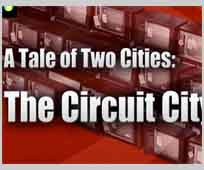
Tom Wulf, 50, just finished “A Tale of Two Cities: The Circuit City Story,” a self-financed documentary that traces the company’s history from its birth on Broad Street to its demise in 2008 and 2009.
The film premieres tomorrow night at the Virginia Film Festival in Charlottesville. Wulf, who moved to Richmond to work in training for Circuit City, said he wants to have a local showing in a month or two.
(You can watch the Trailer below.)
[youtube]http://www.youtube.com/watch?v=fpj7Cf0wBOc[/youtube]
“I had a picture that hung on my wall of [Circuit City founder] Sam Wurtzel, and when I left the company I sent that picture back to Alan, his son. Then I asked him if he’d grant me an interview because I had an idea about a documentary,” Wulf said.
Throughout the movie, Sam Wurtzel is painted as the ballast and spiritual leader of the company. It was his emphasis on customer service that helped the company get off the ground, initially selling TV sets to African Americans from a shop on Broad Street. Then the company added other appliances and soon branched out to other markets.
Through interviews with Alan Wurtzel, former Circuit City presidents and rank-and-file support staff, Wulf explores how one of Wall Street’s darlings went into a slow decline and then collapsed in 2009 after suppliers would no longer lend the company inventory. But that was really just the straw that broke the camel’s back.
The film is broken into two parts: One that explains how the company started in the 1940s and grew as Wards (the name wasn’t changed to Circuit City until the 1980s) and one that explains how it lost its competitive edge over the past 20 years (same-store sales began slipping, Best Buy gained market share, gambles didn’t pay off) and eventually collapsed.
 “In the end, Circuit City put so much emphasis on shareholders and spent so much energy driving up the P/E ratio and stock that they forgot the customers,” Wulf said.
“The company also was on top so long, it didn’t pay attention to competition,” he added. “They stopped listening to the customer service associates.”
Several major figures are not in the film, including former chief executives Rick Sharp and Phil Schoonover, who was voted the worst CEO in America by a national business magazine in 2008.
The film uses lots of videos – former Circuit City ads, internal management training videos and news reports – as it chronologically tries to explain what made the company so successful through the 1980s and what made it sluggish over the past 15 years.
For example, to show how the company kept changing its marketing strategy and slogan, Wulf cuts to old ads. One has the tag line, “We’re with you.”
That was changed in 2004 to, “Just what you needed.”
None of those changes mattered much, according to Wulf’s account. The company made several blunders, such as signing 30-year leases on buildings that were eventually situated in sub-optimal neighborhoods and gambling millions on a failed video rental disc.
Perhaps most fatally, the documentary posits, the company purchased almost a billion shares of its own stock this decade. If it hadn’t done that, the film suggests, it would have been able to weather the recession instead of filing for bankruptcy protection and then liquidating.
 The film, which is 95 minutes, also has powerful interviews from some of Richmond’s top business leaders and from Alan Wurtzel.
Wurtzel speaks candidly and at one point says that during the Schoonover years, the company was just grasping for straws.
“If it didn’t have a good margin, we did not want it,” Wurtzel said of the policy to not stock as much merchandise as archrival Best Buy. “So we did not have games, which was key to attracting kids, and we did not have as many models of computers.”
For Wulf, the film is intensely personal. The former TV journalist left the news business in the 1980s to work as a sales representative for Circuit City in Atlanta. Wulf then worked his way up and was hired in Richmond to work on management training. He then worked at CarMax for 12 years.
Aaron Kremer is the BizSense editor. He has several ideas for documentaries. Please send news tips to [email protected].
Correction: A previous version of this story erroneously said that the company was founded in the 1930s, and that two former executives declined to be interviewed. The company was founded in the 1940s, and the film maker did not approach former CEOs Rich Sharp or Phil Schoonover.
A local filmmaker has turned his lens on his former employer, which also happens to be one of the biggest corporate flameouts in Richmond history.
Tom Wulf, 50, just finished “A Tale of Two Cities: The Circuit City Story,” a self-financed documentary that traces the company’s history from its birth on Broad Street to its demise in 2008 and 2009.
The film premieres tomorrow night at the Virginia Film Festival in Charlottesville. Wulf, who moved to Richmond to work in training for Circuit City, said he wants to have a local showing in a month or two.
(You can watch the Trailer below.)
[youtube]http://www.youtube.com/watch?v=fpj7Cf0wBOc[/youtube]
“I had a picture that hung on my wall of [Circuit City founder] Sam Wurtzel, and when I left the company I sent that picture back to Alan, his son. Then I asked him if he’d grant me an interview because I had an idea about a documentary,” Wulf said.
Throughout the movie, Sam Wurtzel is painted as the ballast and spiritual leader of the company. It was his emphasis on customer service that helped the company get off the ground, initially selling TV sets to African Americans from a shop on Broad Street. Then the company added other appliances and soon branched out to other markets.
Through interviews with Alan Wurtzel, former Circuit City presidents and rank-and-file support staff, Wulf explores how one of Wall Street’s darlings went into a slow decline and then collapsed in 2009 after suppliers would no longer lend the company inventory. But that was really just the straw that broke the camel’s back.
The film is broken into two parts: One that explains how the company started in the 1940s and grew as Wards (the name wasn’t changed to Circuit City until the 1980s) and one that explains how it lost its competitive edge over the past 20 years (same-store sales began slipping, Best Buy gained market share, gambles didn’t pay off) and eventually collapsed.
“In the end, Circuit City put so much emphasis on shareholders and spent so much energy driving up the P/E ratio and stock that they forgot the customers,” Wulf said.
“The company also was on top so long, it didn’t pay attention to competition,” he added. “They stopped listening to the customer service associates.”
Several major figures are not in the film, including former chief executives Rick Sharp and Phil Schoonover, who was voted the worst CEO in America by a national business magazine in 2008.
The film uses lots of videos – former Circuit City ads, internal management training videos and news reports – as it chronologically tries to explain what made the company so successful through the 1980s and what made it sluggish over the past 15 years.
For example, to show how the company kept changing its marketing strategy and slogan, Wulf cuts to old ads. One has the tag line, “We’re with you.”
That was changed in 2004 to, “Just what you needed.”
None of those changes mattered much, according to Wulf’s account. The company made several blunders, such as signing 30-year leases on buildings that were eventually situated in sub-optimal neighborhoods and gambling millions on a failed video rental disc.
Perhaps most fatally, the documentary posits, the company purchased almost a billion shares of its own stock this decade. If it hadn’t done that, the film suggests, it would have been able to weather the recession instead of filing for bankruptcy protection and then liquidating.
The film, which is 95 minutes, also has powerful interviews from some of Richmond’s top business leaders and from Alan Wurtzel.
Wurtzel speaks candidly and at one point says that during the Schoonover years, the company was just grasping for straws.
“If it didn’t have a good margin, we did not want it,” Wurtzel said of the policy to not stock as much merchandise as archrival Best Buy. “So we did not have games, which was key to attracting kids, and we did not have as many models of computers.”
For Wulf, the film is intensely personal. The former TV journalist left the news business in the 1980s to work as a sales representative for Circuit City in Atlanta. Wulf then worked his way up and was hired in Richmond to work on management training. He then worked at CarMax for 12 years.
Aaron Kremer is the BizSense editor. He has several ideas for documentaries. Please send news tips to [email protected].
I wonder if Wulf includes how Circuit City mistreated employees, the class action suites, moving away from commissioned sales professionals. I believe Circuit City’s end really started with the mistreatment of employees and customers. Business really is about people. I think the company lost it’s way when Wurtzel was out of the picture.
I arrived in Richmond in 1985 as Vice President of Design and Construction at Circuit City. While the job didn’t work out as planned I remained a loyal customer for many years. In my opinion there were three major missteps that Circuit City made : The first was Divex, the alternative to video rentals at Blockbuster. The cost of the development was hugh and it was never taken into account that the film studios , as well as competitiors wouldn’t support it. It was a time when Best Buy was close to bankrutcy and , in my opinion, the re-allocation… Read more »
Brian Glass you said it all…worked there for 6 years and everything you said is accurate!
Brian’s terrific & concise analysis from an “insider’s” perspective is so consistent & explanatory with my experiences as an “outsider” (customer). Having worked integrally as part of the metropolitan Richmond’s business community since 1983, I try to support “home grown” business’ & none were more successful than Circuit City in its heyday. However, when we built our home, my wife & i didn’t have the option of purchasing the appliances there, so Best Buy enjoyed those “big ticket” sales. While the margins may not have been as aggressive as Circuit City wanted, I’m sure the volume of sales in that… Read more »
Wanted to buy a HD television. Went to Circuit CIty (support the locals, I thought), although there were a half a dozen sales associates there, no one could give me a straight answer to a question about a price on a floor model. I left. Went to Best Buy down the street. Saw a model that looked good to me but it was up on one of the high shelves. Could not find a free sales associate who could bring it down and answer a few questions. I left. I went to WalMart down the street. No sales associate in… Read more »
My personal concern about the company began when Rick Sharp, then CEO, purchased a large parcel of real estate in Goochland County for development of million dollar plus homes. From experience as president of a local company, I am convinced that a CEO needs to spend full time on running his publicly held corporation without distractions of trying to pad his pocket by diverting attention to personal investments. Sharp did some very good things like starting Carmax, but previously pointed out blunders, and not listening to those in the field about ways to save money or improve sales, indicate the… Read more »
“In the end, Circuit City put so much emphasis on shareholders and spent so much energy driving up the P/E ratio and stock that they forgot the customers,” Wulf said.
Same old, same old. Change “Circuit City” to “Best Products” or “Helig-Meyers” and the statement is still true. There’s always a fine line line to be walked between satisfying Wall Street and keeping the business viable from a customer point of view, and each of these three companies failed to successfully maneuver that line.
I have a friend who worked in CC … was a VERY competent computer tech. He was fired from an $11 an hour job to be replaced by people who had no clue but would sit around and blunder for $7 an hour. As one commenter said, “I wonder if Wulf includes how Circuit City mistreated employees, the class action suites, moving away from commissioned sales professionals. And another, “One moral to take away from the demise of Circuit City is this. The company was created and expanded by merchants and taken down by MBA’s and senior management that bought… Read more »
Max, Undoubtedly, Circuit City’s downfall was caused by poor management. This wasn’t just MBAs at the top, however. The management failings at Circuit City appear to have been across the board. The last time I shopped in a Circuit City was October 2008. At the time, I worked in IT consulting and up until that point our company spent at least several thousands of dollars per month with Circuit city. Not much, but bigger than the average customer walking in the door. I stopped by that October to pickup a simple computer monitor – I saw it listed online and… Read more »
It’s sad to see Circuit City go down. I was an employee there for 7 years. Some of the things that I was reading here are not 100% true. When the company got rid of their appliance section, they did so to make room for the expansion of computers, software and hardware. CD’s and DVD’s were always in the stores. CD’s and DVD’s brought many loyal customers into the stores week after week while picking up batteries and other things they saw while grabbing the latest flick off the shelves. The company lost lots of money and respect when they… Read more »
To Dave S… Magellan was being developed from within to work with DPS by Circuit’s own development team and with Patapsco Designs… It was to be completed into all stores over a 7 year period as it was being deployed and developed at the same time. That brings us to DPS, As old as the system was it was a workhorse after its last upgrade to its mainboard, its downfall was that it was a plain green/white screen AS/400 like terminal looks… Perception was wow all this cutting edge technology and you have this to cash me out on? (This… Read more »
I was in the corporate office for ten years starting in the mid 80s. Fun times back then – we coudn’t do any wrong. I agree with much of what Brian Glass says. Interesting that each of the past CEO’s each had a touch of one of his points. Sharp was a high flyer, not a people person. He did not relate well to the people in the stores. His personality seemed more inclined toward creating something new rather than sustaining a brand. It would seem he origianlly got the job by being in the right place at the right… Read more »
I worked for circuit city for 8 yrs. in the beginning circuit city was very customer oriented, but as time went on it was all about the all mighty dollar. whatever had the most margin, that is what we were told to push. no one mentioned mid level management. they were a high flying bunch of idiots. everything had to be first class for them from airline travel to lavish dinners and parties. circuit city went under because of terrible management on all levels,…. good ridance!!!!!